
GCP Google Cloud Platform Interview Questions for Experienced
1. What is Google Cloud Platform?
Google Cloud Platform is a set of Computing, Networking, Storage, Big Data, Machine Learning and Management services provided by Google that runs on the same Cloud infrastructure that Google uses internally for its end-user products, such as Google Search, Gmail, Google Photos and YouTube.
2. What is cloud computing?
Let’s start with the most basic question of all. Cloud computing is the computational power, which is on the cloud at all times. It uses the Internet as its chosen method of delivery. The service of this technology is global and not limited by geographical restrictions.
3. What is cloud?
You can simply state that cloud is a combination of network, storage, interface, and hardware that offers cloud computing as a service. A cloud service provider takes care of the cloud and IT assets of the company that is offering the cloud services.
4. What are the main features of cloud services?
Cloud service and cloud computing as a whole have a multitude of features, especially the ease of access and management of commercial software from anywhere around the globe.
- Easy centralization of all management related to software to a central web service
- The design and development of web applications capable of handling multiple clients from anywhere arond the world simultaneously
- The elimination of software upgrade downloads by centralizing and automating the updating process
5. What are the advantages of using cloud computing?
First let us compare Google Cloud with AWS Cloud:
* Criteria * Google Cloud * AWS
Data Centers Relatively less Large number
Market Position In top three Market leader
Entry in cloud Late entrant Very early entrant
The advantages of using cloud computing are many. Here we will discuss some of the most important advantages of the cloud. You will be able to store and have a backup of the data anytime, it has powerful server capabilities, improves productivity, cost-effectiveness and time saving, ability to get up and started in the shortest duration of time.
6. Mention platforms that are used for large-scale cloud computing?
The platforms that are used for large-scale cloud computing are Amazon Web Services, Azure, Google Cloud Platform, and more.
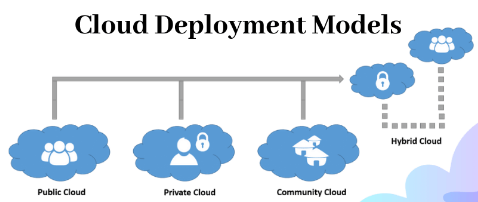
7. What are the different models for deployment in cloud computing?
The various deployment models in cloud computing are private, public, and hybrid cloud.
8. How can a user gain from utility computing?
Utility computing is the service wherein you get pay-as-you-go and on-demand services in which the provider offers to manage and operate the computing services and you can choose which services to access which are all deployed in the cloud.
9. When you are transferring data, how do you ensure it is secure?
To ensure that the data which is being transported is secure you should check the encryption key implemented and there is no leak in the data.
10. Describe the security aspects that the cloud offers?
Some of the important security aspects that the cloud offers are as below:
- Access control: it offers control to the users who can control the access to other users who are entering the cloud ecosystem
- Identity management: this provides the authorization for the application services
- Authorization and authentication: this security feature lets only the authenticated and authorized users to access the applications and data.
11. What are system integrators in Cloud Computing?
The cloud can consist of multiple components that can be complex. The system integrator in the cloud is the strategy that provides the process of designing the cloud, integrating the various components for creating a hybrid or a private cloud network among other things.
12. What are the various components of the Google Cloud Platform?
The various GCP components are:
- Google Compute Engine
- Google Cloud Container Engine
- Google Cloud Storage
- Google Cloud App Engine
- Google Cloud Dataflow
- Google Cloud Machine Learning Engine
- Google BigQuery Service
- Google Cloud Job Discovery
- Google Cloud Endpoints
- Google Cloud Test Lab
13. What are the main advantages of using Google Cloud Platform?
Google Cloud Platform is gaining popularity among cloud professionals as well as users for the advantages they offer over others :
- GCP offers competitive pricing
- Google Cloud servers allows access to information from anywhere
- GCP has an overall better performance and service compared to other hosting cloud services
- Google Cloud provides speedy and efficient server and security updates
- The security level of Google Cloud Platform is exemplary; the cloud platform and networks are secured and encrypted with various security measures.
14. How does cloud computing provide on-demand functionality?
As a technology, cloud computing was built on the foundation of providing functionality to all its users on demand at anytime and from anywhere. With the latest advancements and easy availability of applications like Google Cloud, it has achieved that goal.
A user on Google Cloud can view the files on the cloud on any device at any time from wherever they are as long as they are connected to the internet.
15. What are the various layers in the cloud architecture?
The different layers that constitute the cloud architecture are:
- Physical layer: This constitutes the physical servers, network, and other aspects
- Infrastructure layer: This layer includes storage, virtualized layers, and so on
- Platform layer: This includes the operating system, apps, and other aspects
- Application layer: This is the layer that the end-user directly interacts with.
16. What are the libraries and tools for cloud storage on GCP?
JSON API and XML API are at the core level for the cloud storage on Google Cloud Platform. But along with these, Google also provides the following to interact with the cloud storage.
- Google Cloud Platform Console to perform basic operations on objects and buckets
- Cloud Storage Client Libraries that provides programming support for various languages
- GustilCommand-line Tool provides a CLI for the cloud storage
There are also a number of third party libraries and tools like Boto Library.
17. What is “EUCALYPTUS” in the context of cloud computing?
“EUCALYPTUS” stands for “Elastic Utility Computing Architecture for Linking Your Programs To Useful Systems”, which is an open-source cloud computing infrastructure that is used for deploying cloud clusters. Using the “EUCALYPTUS”, you can build public, private, and hybrid cloud platforms. You can even have your own data center in the cloud and this can be used to harness its functionality in your organization.
18. What is Google Compute Engine?
Google Cloud Engine is the basic component of the Google Cloud Platform. It is an IaaS that provides flexible Windows and Linux based virtual machines that are self-managed and hosted on the Google infrastructure. The virtual machines can run on local, durable storage options, and KVM.
For the purpose of control and configuration, Google Cloud Engine also includes REST-based API. It integrates with other GCP technologies (Google Cloud Storage, Google App Engine, Google BigQuery, etc.) that help extend its computational ability thus creating more complex and sophisticated applications.
19. What are the different methods for the authentication of Google Compute Engine API?
There are different methods for the authentication of Google Compute Engine API. They are:
- Through client library
- Using OAuth 2.0
- Directly using an access token
20. Why do you need the virtualization platform to implement cloud?
Virtualization lets you create virtual versions of the storage, operating systems, applications, networks, and so on. If you use the right virtualization then it helps you to augment your existing infrastructure. You are able to run multiple apps and operating systems on existing servers.
21. What are some of the popular open-source cloud computing platforms?
Some of the important open-source cloud computing platforms are as below
- OpenStack
- Cloud Foundry
- Docker
- Apache Mesos
- KVM
22. Explain what are the different modes of software as a service (SaaS)?
The two most important types of software as a service are as below:
- Single multi-tenancy: In this type of SaaS you have your own independent resources that you don’t share with anybody
- Fine grain multi-tenancy: In this type of SaaS deployment the resources are shared between multiple tenants even though the functionalities remain the same.
23. What is the benefit of API in the cloud domain?
Here we list the important benefits of API with respect to the cloud domain:
- You don’t have to write the complete program
- You can easily communicate between one application and another
- You can easily create applications and link them to the cloud services
- It seamlessly connects two applications in a secure manner.
24. Mention what is the difference between elasticity and scalability in cloud computing?
Scalability in the cloud is the way in which you increase the ability to service additional workloads either by adding new servers or accommodating it within the existing servers. Elasticity is the process by which you can either add or remove virtual machines depending on the requirement in order to avoid wastage of resources and reduce costs.
25. What are the service accounts? How will you create one?
This is one of the most common Google Cloud interview questions. Service accounts are the special accounts related to a project. They are used for the authorization of Google Compute Engine in order to be able to perform on behalf of the user thus receiving access to non-sensitive data.
There are different service accounts offered by Google but mainly, users prefer to use Google Cloud Platform Console and Google Compute Engine service accounts.
The user doesn’t need to create a service account manually. It is automatically created by the Compute Engine whenever a new instance is created. Google Compute Engine also specifies the scope of the service account for that particular instance when it is created.
26. What are projects in the context of Google Cloud?
Projects are the containers that organizes all the Google Compute resources. They comprise the world of compartments and are not meant for resource sharing. Projects may have different users and owners.
27. Suppose you have deleted your instance by mistake. Will you be able to retrieve it back? If yes, how?
While It is a very simple question, it is based on the deep understanding of the Google cloud platform. The answer is no. It is not possible to retrieve the instances that have been deleted once. However, if it has been stopped, it can be retrieved by simply starting it again.
28. What is Google BigQuery? What are the benefits of BigQuery for the data warehouse practitioners?
Google BigQuery is used as a data warehouse and stores all the analytical data in an organization. It organizes the data table into datasets.
Some of the benefits of BigQuery for the data warehouse practitioners are:
- BigQuery allocates query and storage resources depending on the requirement and usage. Therefore, it doesn’t require the provisioning of resources before usage.
- It can store data in different formats for efficient storage management. For example, Google’s distributed file system, proprietary format, proprietary columnar format, query access pattern, etc.
- It is fully maintained and managed without any downtime or hindrance.
- It provides backup and disaster recovery at a broader level. Users can easily undo changes and revert to a previous state without making a request for the backup recovery.
29. What do you know about Google Cloud SDK?
Google Cloud SDK (Software Development Kit) is a set of tools that are used in the management of applications and resources that are hosted on the Google Cloud Platform. It is comprised of the gcloud, gsutil, and bqcommand line tools.
Google Cloud SDK runs only on specific platforms like Windows, Linux, and macOS and requires Python 2.7.x. Other specific tools in the kit may have additional requirements as well.
30. What are the Google Cloud APIs? How can you access them?
Google Cloud APIs are programmatic interfaces that allow users to add the power of everything (from storage access to the image analysis based on machine learning) to Google Cloud-based applications.
Accessing Google Cloud APIs :
Cloud APIs can be easily accessed with the client libraries from the server applications. A number of programming languages can be used to access Google Cloud APIs. One can use use mobile applications via Firebase SDKs or through third-party clients. Google Cloud Platform Console Web UI or Google SDK command line tools can also be used to access the Google Cloud APIs.
31. Which parameter is used to tell BigQuery to automatically detect the schema of a file on import ?
–autodetect
32. What is Pub/Sub in Google Cloud ?
It is an asynchronous messaging service that decouples services that produce events from services that process events.
33. What is the command to Install Kubectl command line tool in Google Cloud ?
gcloud components install kubectl
34. What is the command to authenticate through Docker Container Registry ?
gcloud auth configure-docker
35. How to set project in GCP using gcloud command ?
gcloud config set project
36. How to set Compute zone to “us-east1” in GCP using gcloud command ?
gcloud config set compute/zone us-east1
37. How to create a Google Kubernetes Clusters “test-cluster” using gcloud command ?
gcloud container clusters create test-cluster –num-nodes=2
38. How to check all the instances running in GCP using gcloud command ?
gcloud compute instances list
39. Which Google Kubernetes Clusters location type provides high availability ?
Regional
40. Which of the operating systems support Google Cloud SDK ?
Below operating systems supports Google Cloud SDK:-
- Linux
- Debian/Ubuntu
- RedHat/CentOS
- MacOS
- Windows
41. In which of the VMs Persistent Disk Storage can be attached ?
Persistent Disk Storage can be attached to VMs in Google Compute Engine(GCE) and Google Kubernetes Engine(GKE).
42. When HDDs are preferred over SSDs storage ?
HDDs are usually preferred when storing large amounts of data and performing batch operations that are less sensitive to disk latency than interactive applications.
43. Which version of Redis is currently supported on Google Cloud ?
Redis 3.2
44. Which Service is used in Google Cloud(GCP) for In-Memory Cache ?
Memorystore
45. Which database service is used to scale databases resources vertically ?
Cloud SQL
46. Which database service is used to ensure consistency and transaction integrity for extremely large amount of data ?
Cloud Spanner
47. Which Service is used for Data Warehouse and Analytics Applications to handle large amount of columns and rows ?
BigQuery
48. What are different NoSQL databases used in GCP ?
Below are the three NoSQL databases used in GCP :-
- Cloud Datastore
- Cloud Firestore
- Cloud Bigtable
49. What is the main advantage of Using Cloud Firestore NoSQL database ?
Its main advantage is for storing, synchronizing and querying data across distributed applications like mobile apps.
50. Is Bigtable a wide-column database or document database ?
It is a wide-column database. Check more about Bigtable on Official Documentation.
51. What are different data storage systems available in Cloud Firestore ?
There are two data storage systems available in Cloud Firestore:-
- Using Firestore in Datastore mode.
- Using Firestore in Native mode.
52. How to Create a bucket name test_bucket in GCP ?
gsutil mb gs://test_bucket/
53. What is the syntax to create a bucket using gsutil command in GCP ?
gsutil mb gs://test_bucket/
54. What is the permission required to create backups in GCP ?
datastore.databases.export
55. What is the permission required to import data in GCP ?
datastore.databases.import
56. What is the syntax to create a backup using gcloud command ?
gcloud -namespaces='[NAMESPACE]’ gs://[BUCKET_NAME]
57. What is the syntax to import a backup file in GCP ?
gcloud datastore import gs://[BUCKET]/[PATH]/[FILE].overall_export_metadata
58. Which BigQuery command can be used to estimate how much data will be scanned ?
bq –location=[LOCATION] query –use_legacy_sql=false –dry_run [SQL_QUERY]
59. What is the command to create a topic in GCP ?
gcloud pubsub topics create [TOPIC-NAME]
60. What is the command to create a subscription in GCP ?
gcloud pubsub subscriptions create [SUBSCRIPTION-NAME] –topic [TOPIC-NAME]
61. How to configure cbt in Cloud SHELL ?
Use below command to configure cbt in cloud shell:-
- gcloud components update
- gcloud components install cbt
62. How to create a table “example-table” using cbt command ?
cbt createtable example-table
63. How to list all the tables using cbt command ?
cbt ls
64. How to create a family called “test-family” using cbt command ?
cbt createfamily example-table test-family
65. How to display the contents of table “example-table” ?
cbt read example-table
66. What is the command to create a cluster named “Test-Cluster” in “us-west2-a” zone ?
gcloud dataproc clusters create Test-Cluster –zone us-west2-a
67. How to Submit a Job “example.jar” on the Cluster “Test-Cluster” Using gcloud command ?
gcloud dataproc jobs submit spark –cluster Test-Cluster –jar example.jar
68. What is the command syntax to manually change the Bucket Storage Class ?
gsutil rewrite -s [STORAGE_CLASS] gs://[PATH_TO_OBJECT]
69. How to Copy hello.txt file from /root folder to Test-Bucket ?
gsutil cp /root/hello.txt gs://Test-Bucket/
70. What is the command to download hello.txt file from Test-Bucket bucket to /root directory ?
gsutil cp gs://hello.txt /root/
71. What is Google App Engine or GCP App Engine?
Google App Engine also known as GCP App Engine is a serverless platform that provides the capability to run your code directly and ensures the availability of your application. Google manages the servers and other infrastructure for you. GCP App Engine is responsible for providing all built-in services and APIs as traffic to your site grows so you only pay for the resources you use.
App Engine sometimes referred to as GAE is a Platform as a Service platform to build scalable web applications in Google managed data centers. It provides integration to different development tools like Jenkins, Eclipse, Git, IntelliJ, Maven to build your applications without changing your workflow.